THE MOVING BODY - Walking Gait Analysis (Part IV): Gait speed and Running
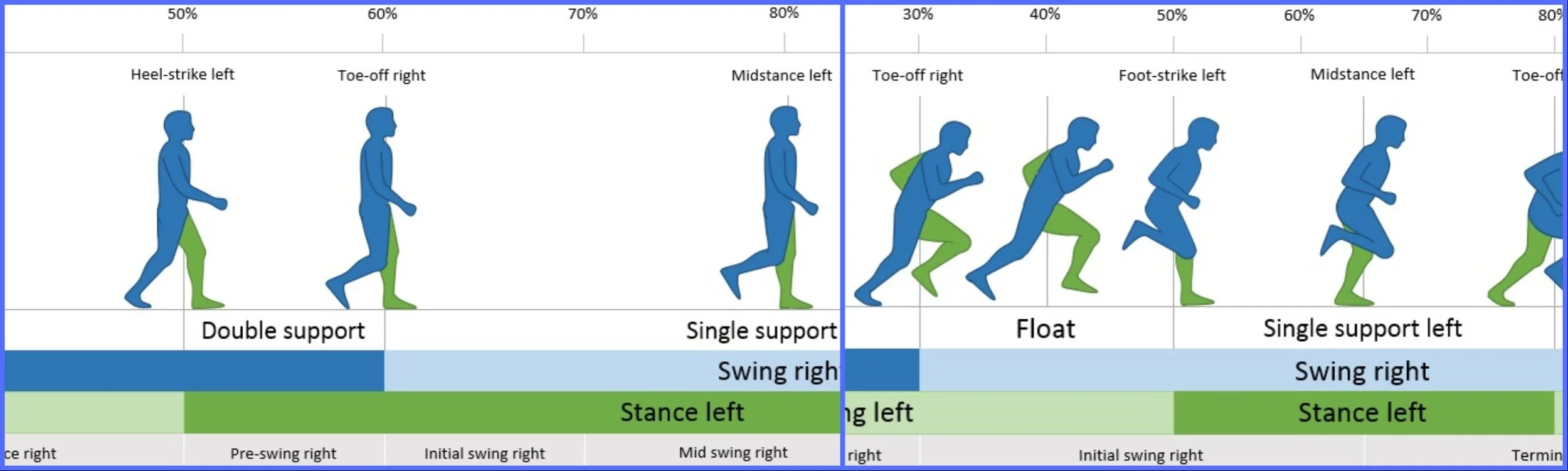
INTRODUCTION
From parts I to III of the series, we went into the details of the walking gait. We covered several sets of mechanics that contribute to the dynamics of a walking gait; we covered the muscles involved in the creation of successful movement, and what part of unsuccessful movement might feel and look like. But generally, in all of it, we always assumed the speed of the gait to be one.
In this article, we are going to revisit most of these points and see how they adapt, apply, and interact at different walking speeds. As it turns out, there is a lot more to changing velocity than what you might imagine being "just walking faster".
We can consider what most people see as their preferred walking speed as the baseline we have covered so far, our 1.0x, if you will. This is usually the speed each one of us tends to gravitate towards and feel more comfortable with, the speed we choose if we are not forced by external or internal forces to change (which there is a good chance of this conveniently falling into being the most energy efficient for each person).
In the next small paragraph of this article, we will cover what happens when we go below that speed, like a gentle stroll; we'll see how a few things change when we pick up our pace while still remaining in a walk. And after we hit that wall, we'll see not only what the main differences are in running, but also how forces change between a casual person running and a more advanced sprinter, to see how they maximize their forward output.
/!\ This is not a medical article. It's simply a study of movement /!\
SLOW WALKING
You can imagine slow walking as taking a gentle stroll through a park or a museum.
Slow walking isn't as simple as walking in slow motion; many things, from muscle activity to form and movement dynamics, are affected by the change in speed.
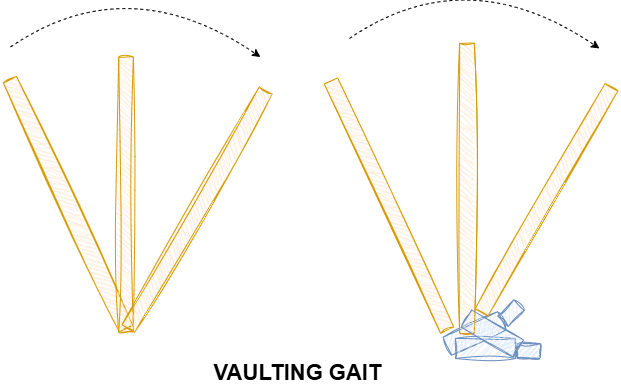
To begin, the slow walking model looks a lot like the dynamics of an inverted pendulum, making use of its passive systems and straight limbs to propel itself forward. In an inverted pendulum model of walking, legs keep relatively straight to save energy when catching the weight of the body. In slow walking, vertical displacement of the center of gravity is minimal, so generally speaking the skeletal system alone is enough to handle absorbing the weight of the body. Using the passive skeletal alignment rather than muscles obviously greatly reduces the amount of energy spent each step. With your legs fully straight, during the single-leg support phase of the cycle, your body "vaults" over the fixed leg, giving the gait its name.
You can see this passive system in action in a system that, even if deprived of all muscles, finds its way into a gentle stroll if given a gentle initial push and a small incline.
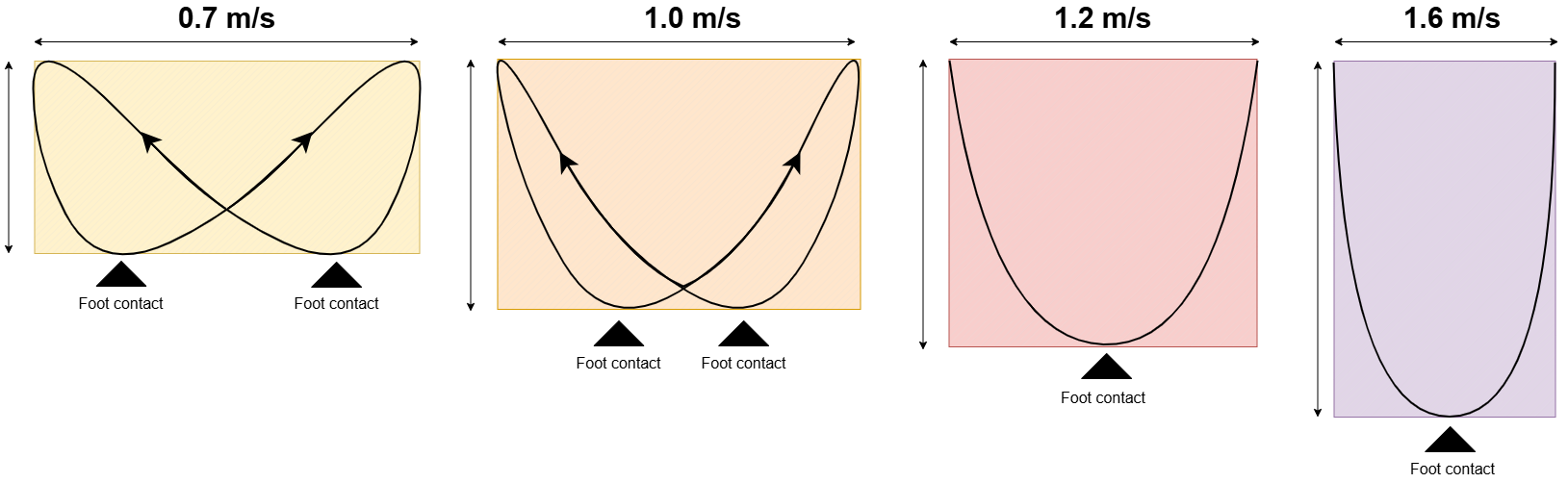
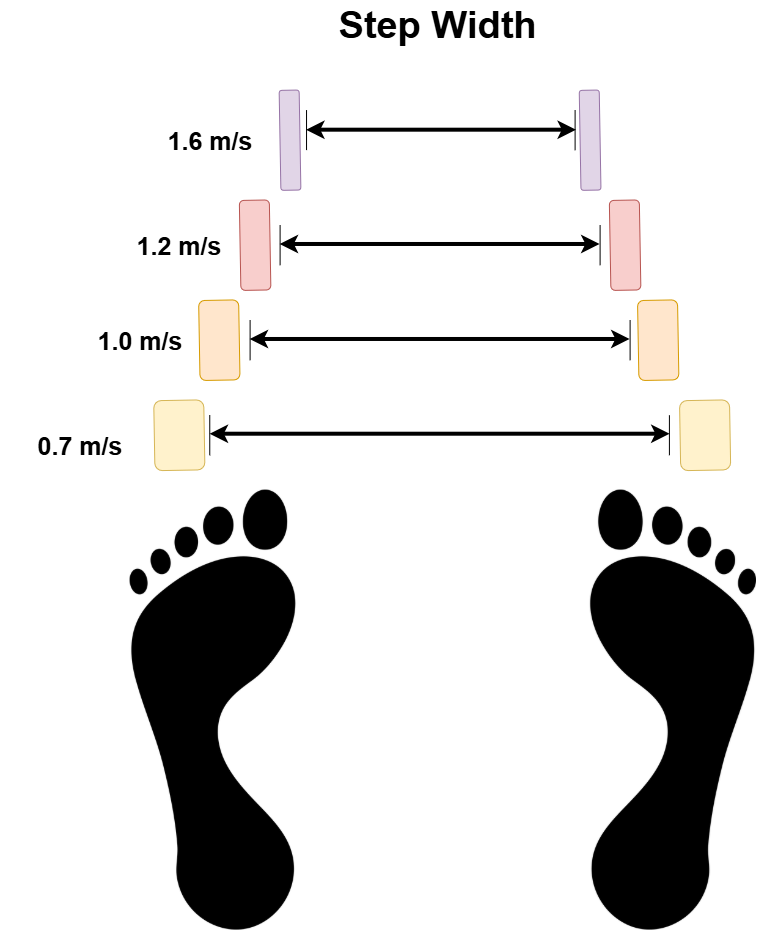
The stride length on slow walking tends to be very small, with a wide stance of the feet. The legs tend to align straight down from their location at the hip joint rather than rejoining the feet towards the midline. Naturally, in slow walking the body takes more time for each step, but that added time to each step is not evenly spread. The weight-shifting middle part of the transitions left/right of the hips stays relatively fast, while most of the added time to the gait is held on the extreme sides as the weight is suspended on one leg. Because of the slower movement and the wider stance, the cog generally has a wider movement side to side, with the foot contact dips being to the side of the midline. The increase wait time on the stance leg means that the upper part of the body has to align more over the foot to create stability and balance, and the wider stance means that the cog will have to go further to the side to find that balance.
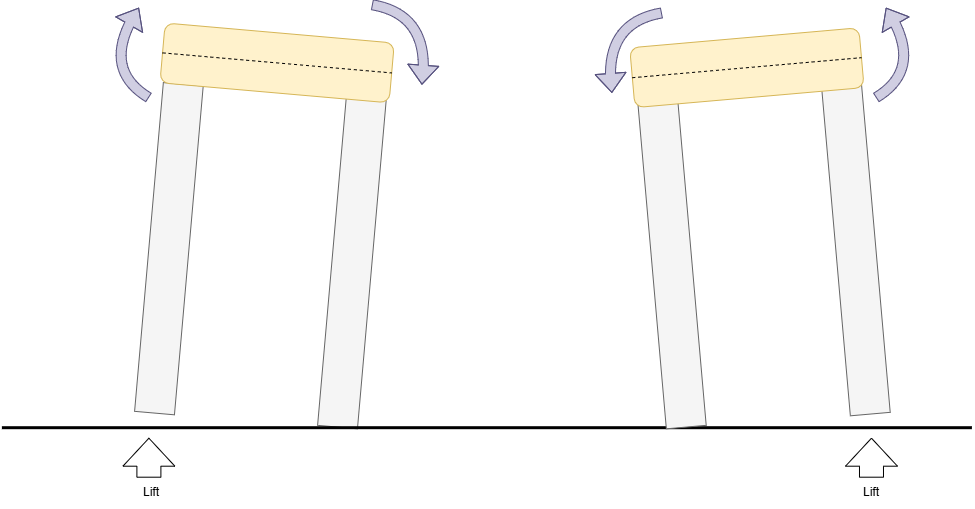
Since active muscles are less involved in this slow walk, during leg advancement the moving leg also tends to stay rather straight (outside of a small amount of passive bending of the knee). But keeping the leg straight during the leg advancement stage of the gait can sometimes pose difficulties in clearing the floor with the advancing foot. I noticed that, with the greater time spent on one side, the body naturally tends to lean a bit more extremely on that side, lifting the hip joint on the opposite side and helping the straight leg clear the floor for the next step. This combination of adaptation can make the stroll, or slow walk, feel a bit more like a "waddle". In short, when we stroll, our stance position is wider, and we spend more time on each stance side. But all these things change as speed increases.
FAST WALKING
You can picture fast walking as the one you might have while being slightly rushed but without the need to run just yet.
Just as all parts of the gait don't scale uniformly as we slow down, as we speed up from our body's natural speed to a fast walk, not all aspects of the cycle change in unison. If we start from a slower walking speed and pick up the pace, at first we generally extend our step length to speed up (take bigger steps) before we commit to increasing our step rate (take faster steps) to reach the faster walking speed.
STEPS LENGTH AND SPEED
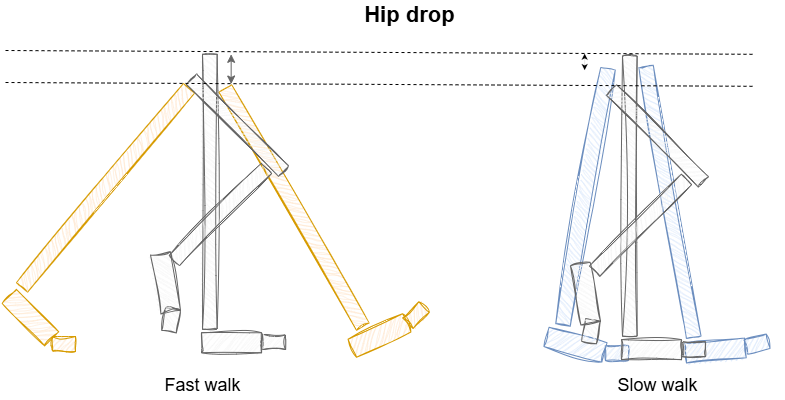
To make a step physically longer, the body increases the angle of the legs during ground contact, together with a more extreme rotation of the hips, consequently lowering the hips more than they would at a slower pace. During the passing position, on both fast and slow walking, the hip's height would remain the same as in slow walking, but since the ground contact position lowers, the general vertical displacement of the hips of the fast gait greatly increases. The body needs to devote more resources to absorbing the weight of each step, adding greater emphasis on bending the knee during this phase of weight acceptance to absorb the extra weight of the body. We involve the quadriceps muscle more, together with increased glute activation.
HIPS
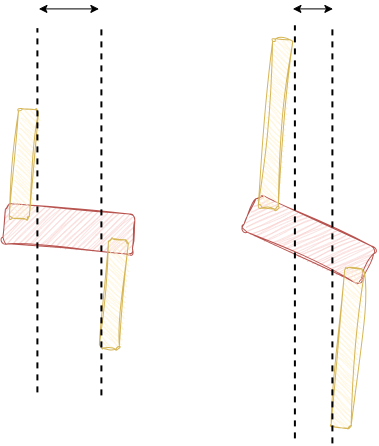
With an increased rotation of the hips, naturally the footfall of our walk becomes narrower, falling in a straighter line. At the same time, a more extreme rotation of the hip joint requires a bigger counter-rotation of the top part of the body to keep the body stable and aiming forward. As we raise our walking speed, the arms, rather than passively swinging, take on a more active role to keep up with the tighter timing and increase in amplitude.
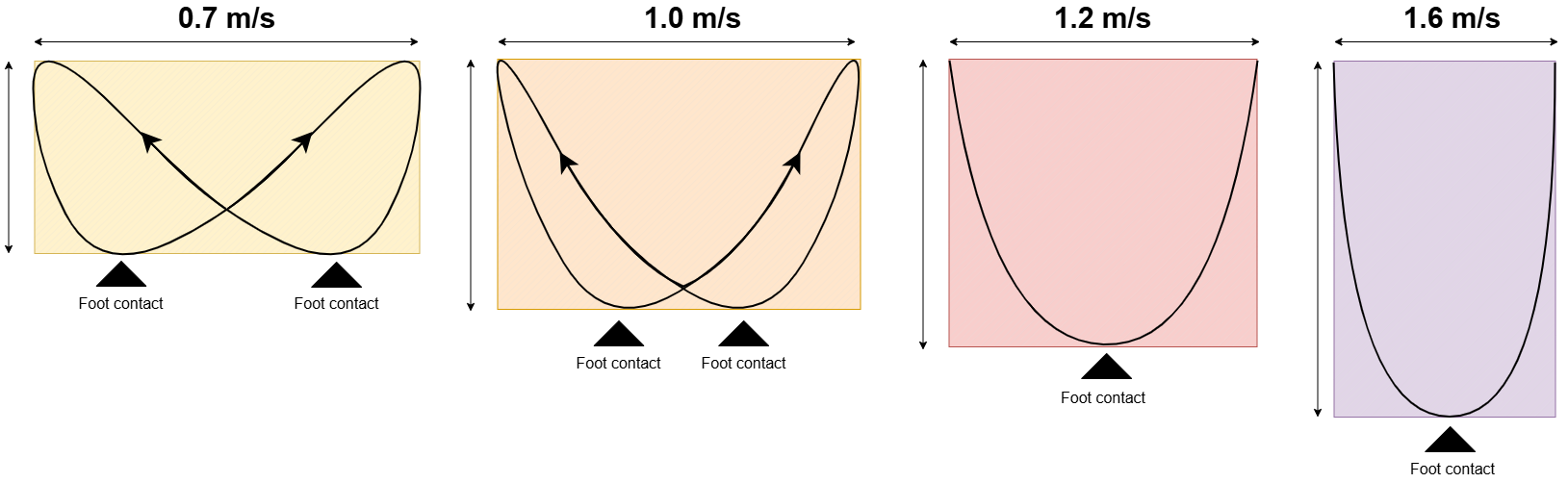
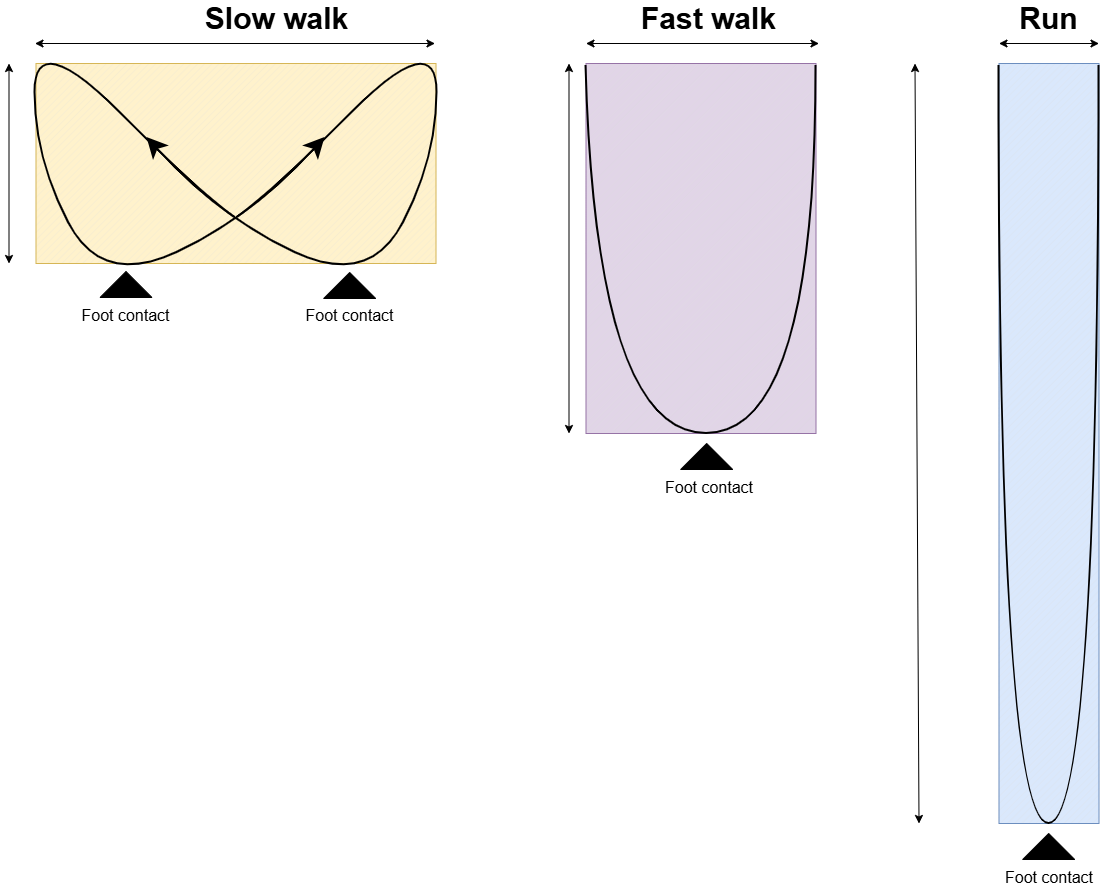
With increased speed, the pattern of the hips becomes narrower and taller, and the down position merges toward the middle, compared to the bottom placement being displaced to the side at slower paces. The more speed increases, the more the hips will streamline their path and move in a straight line forward rather than swinging side to side like a pendulum.
For the most astute observers, you might have been able to notice that as we increase our walking speed, we are transitioning from a reverse pendulum mechanics we had while strolling to active spring, which is where we are headed with running.
CASUAL RUNNING
The more we force ourselves to move faster, the lower our lowest position of the hips becomes, and the more energy we need to put into our push-off with the back leg. As we increase our strength more and more, the lighter our body gets as we lift our back foot, to the point where our muscles would completely cancel the force of gravity for a small moment of full-body suspension. If we continue to increase our pushing force, we would exceed this lift, creating a moment where both our feet are forced to lift from the ground and getting into a full run. But as we speed up from a fast walk, rarely do we push our gait so far that it mechanically transitions into a run on its own; we generally avoid that awkward middle stage and transition into a run much sooner. If the average walking speed is around 4.8 km/k (or 3 mph), while the average fast walking speed is around 5.6 km/h (or 3.5 mph), jogging can vary from 6.5 to 10 km/h (or 4 to 6 mph).
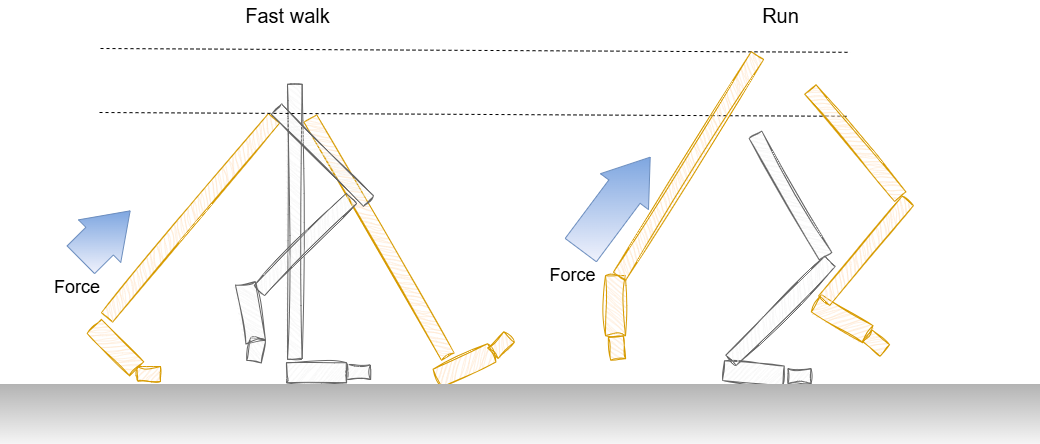
Officially, the moment both our feet are lifted from the ground during the passing position is the moment we have transitioned into a run. If you think about it, all we do when jogging is try to extend the length of our steps beyond what might be physically possible in a walk. Hence, we add a small "hop" from one foot to the other. As we do that, our back-kicking leg is mechanically fully transformed from a reverse pendulum into a spring propelling us both forward and up.
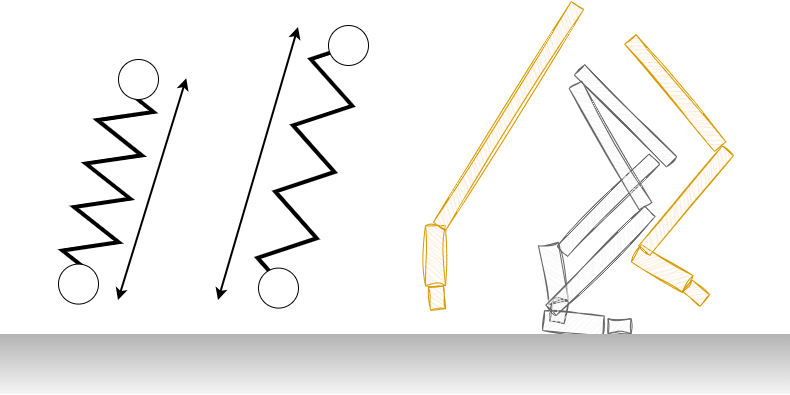
Though it might not sound as effective as a rolling egg in terms of efficiency, springs also have a way of loading and releasing tension that cyclically recycles energy. Using the force of gravity to load up the spring, then release the same energy plus some to propel the body up so that it can fall again, loading up the spring one more time.
If you want something more in detail on how this mechanism works, feel free to refer to this article: https://www.animatornotebook.com/blog/anatomy-in-motion-4
PHASES OF RUNNING
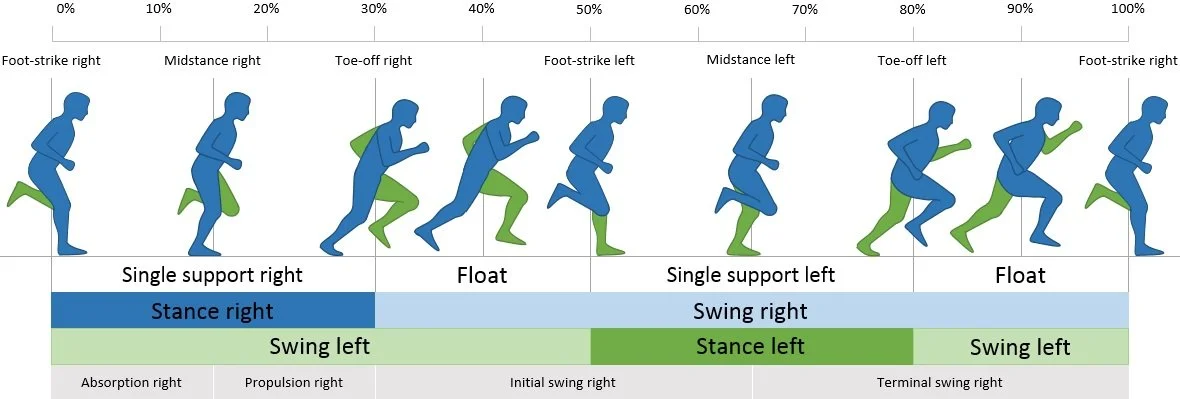
Though the form may change, the phases of running still generally hold true to the same tasks that the walking gait needs to clear. Most notably, we find an initial contact portion of the gait where the foot lands and absorbs the weight of the body, followed by a phase of one-leg stability, posterior propulsion (pushing backwards), and a swing of the leg towards the front of the body.
INITIAL CONTACT
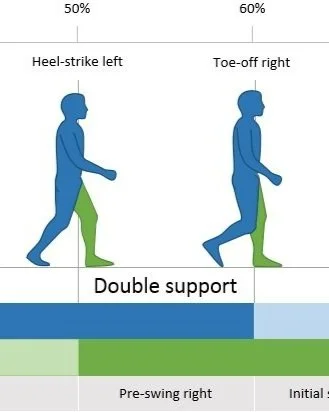
The main difference between the walking and running gait is the lack of a double support phase, being replaced by a double suspension instead. The shock absorption of a running initial contact generally involves much more muscle activation, as ground reaction forces can oscillate between two and six times those during walking.
Foot position during landing on a run can also vary greatly from run to run. Heel contact is not a staple of a run and can be easily skipped, as some people's first contact can more naturally fall with the midfoot or forefoot instead.
Foot landing position in a run also falls a lot closer to the midline of the body compared to walking, where our gait stance is wider.
Ground contact comparison:
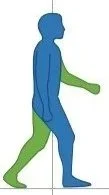
Walking gait ground contact
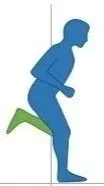
Running gait ground contact
MID STANCE and PUSH OFF
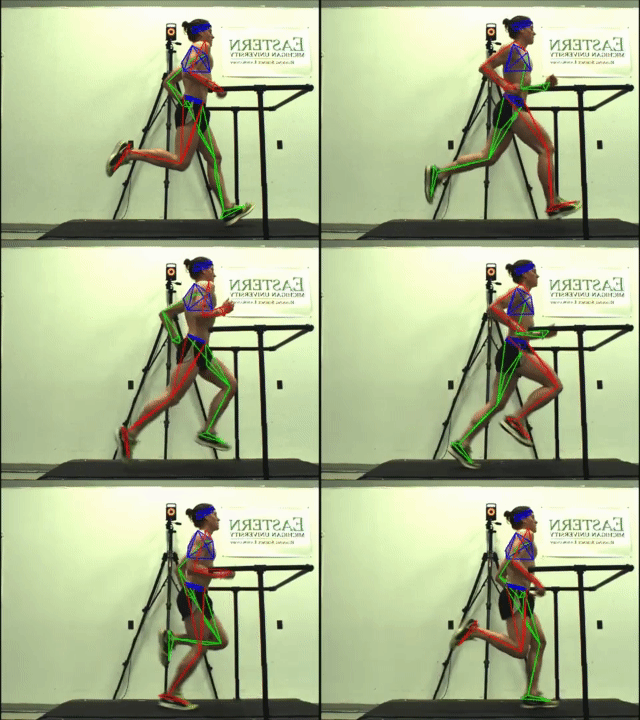
Generally similar to walking, with more muscle activation and knee flexion. The upper part of the body is a lot more involved in running, both in body twist and arm involvement, depending on the intensity of the run.
Compared to walking, where the percentage of the gait is divided into 60% for stance and 40% for swing, running flips the numbers by spending only 40% of the running gait in stance, and maximizing airtime with it occupying 60% of the gait.
Mid stance comparison:
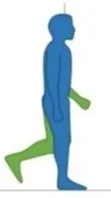
Walking gait Mid stance
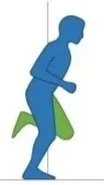
Running gait Mid stance
Toe-off comparison:
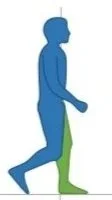
Walking gait Toe-off
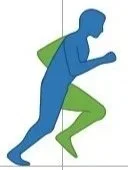
Running gait Toe-off
FOLLOW THROUGH and FORWARD SWING
Foot forward comparison:
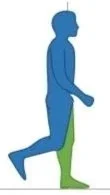
Walking gait Foot forward
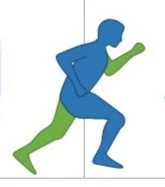
Running gait Foot forward
Generally similar in scope to the walking gait, with the main difference being the last of the opposite leg support, even when pulling the back leg forward.
In a run, the arms are generally kept compact and close to the body, probably to avoid the excessive amount of swing that a straight, loose arm would go through if left unaccounted for.
Hip pattern running also changes drastically from walking. We lose some of the complexity of the horizontal figure 8 to replace it with a simplified U shape instead. Vertical displacement in a run is much greater as well, while lateral displacement is comparatively reduced.
ACCELERATION AND SPRINTING
When we want to run as fast as possible, there are a couple of considerations to keep in mind. First, we ignore metabolic efficiency. Sprinting isn't about running efficiently, but about producing the highest absolute force output. Second, there are a few changes in posture and form from running to sprinting, but for the most part, they will all focus on two main aspects: maximizing horizontal force and minimizing friction.
ACCELERATING
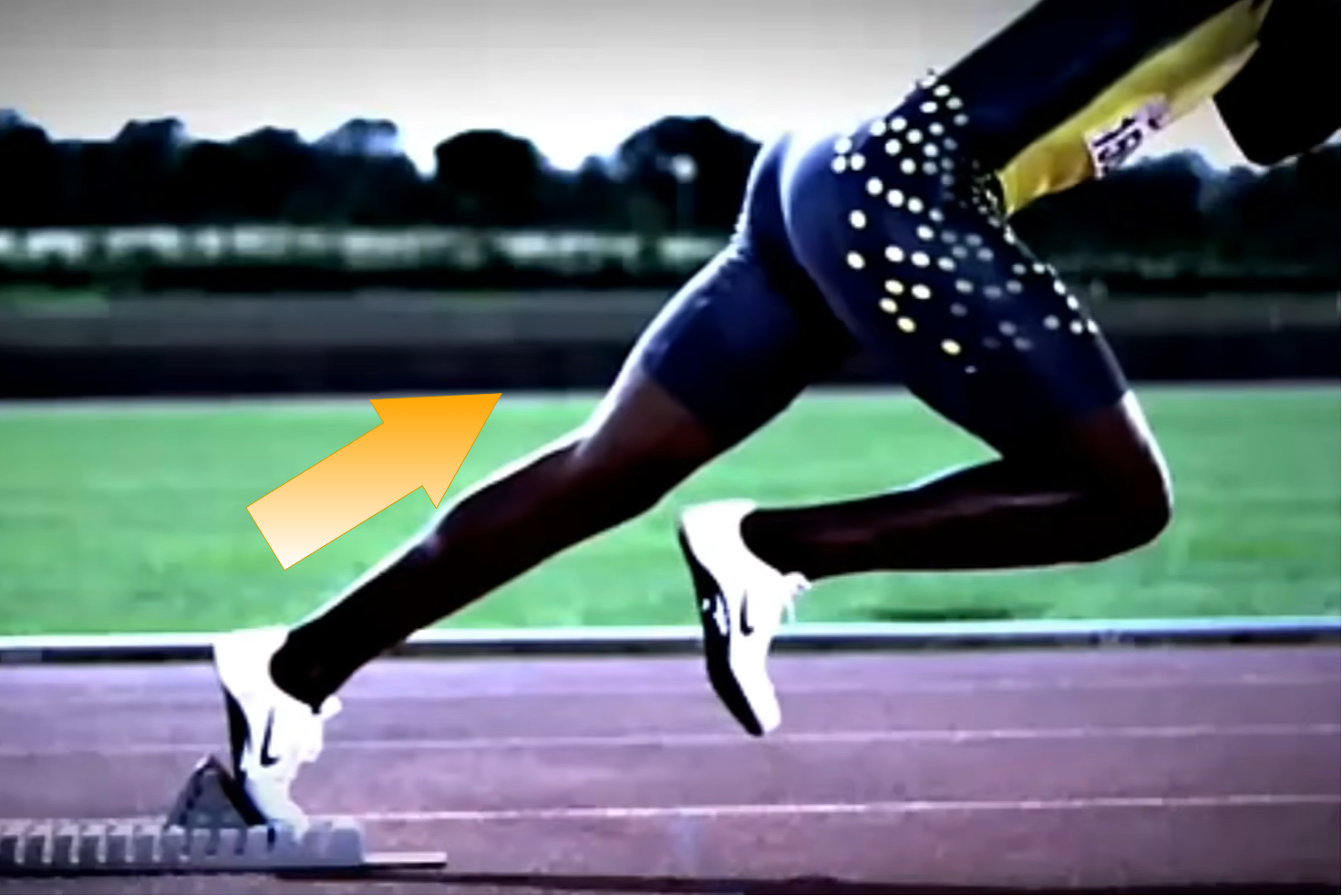
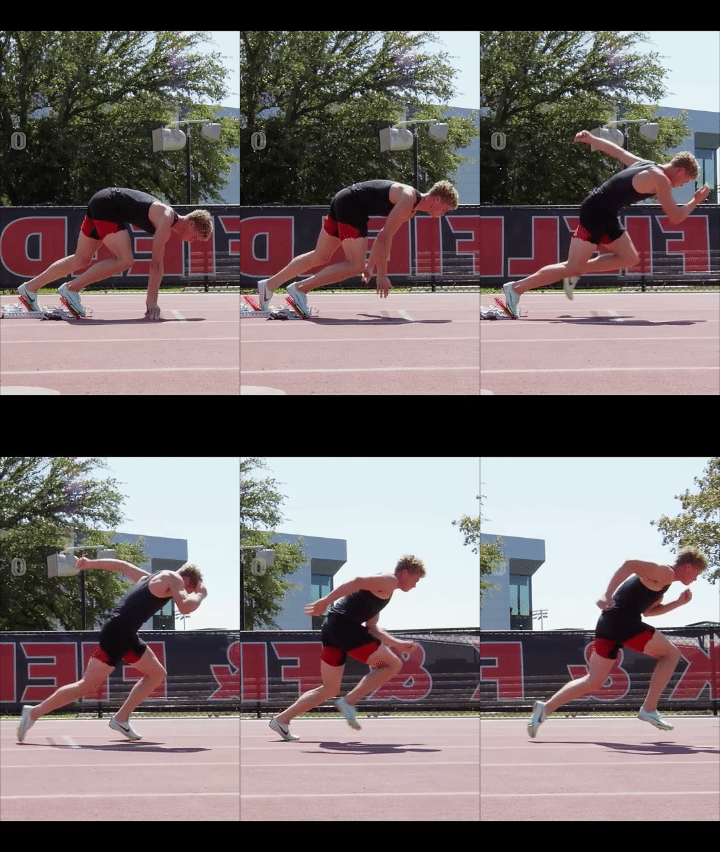
When accelerating from a still position, the runner wants to focus on reaching peak velocity as quickly as possible. The main focus falls on the propulsion phase of the gait, going from mid-support to toe-off. A few changes that appear evidence is the main position of the body. When taking the first steps, the body is extremely forward-leaning. This helps ensure that the majority of the force produced by pushing the ground with the back leg goes into forward displacement rather than vertical. Part of running or accelerating efficiently is to generate the minimal amount of vertical displacement to avoid falling, but not so much that as much of the force generated pushes the runner forward.
https://www.youtube.com/shorts/gy638fHZ2O8?feature=share
Since propulsion is the main force-generating asset at this stage, runners are usually incentivised to increase the frequency of strides while lowering the length of each step. Comparatively, taking more steps rather than longer steps will maximize force production in the same amount of time.
In the first few steps of the sprint, the base of contact of the feet is larger than usual. It generally helps with keeping balance, generating a larger force, and maintaining a lower position of the body. As we gain speed, though, gradually the feet come together in the middle for narrower steps.
You might have also noticed that the contact position looks very different from what we envision in a standard run. Especially during the first steps, contact with the ground happens on the forefoot rather than the heel to keep maximizing forward force production. We will discuss the difference in more detail soon.
The arms and upper body also contribute by forcefully swinging rather than being passive, helping the body load and release the elastic energy at a higher pace.
SPRINTING
In the grand scheme of things, sprinting covers the basic dynamics of the run, with similar muscle activation and phases. With a few caveats and adjustments that make sprinting more effective in reaching and maintaining max speed.
As we reach max velocity, the body gradually moves to a vertical position on the spine, and the arm's swing becomes more contracted and contained.
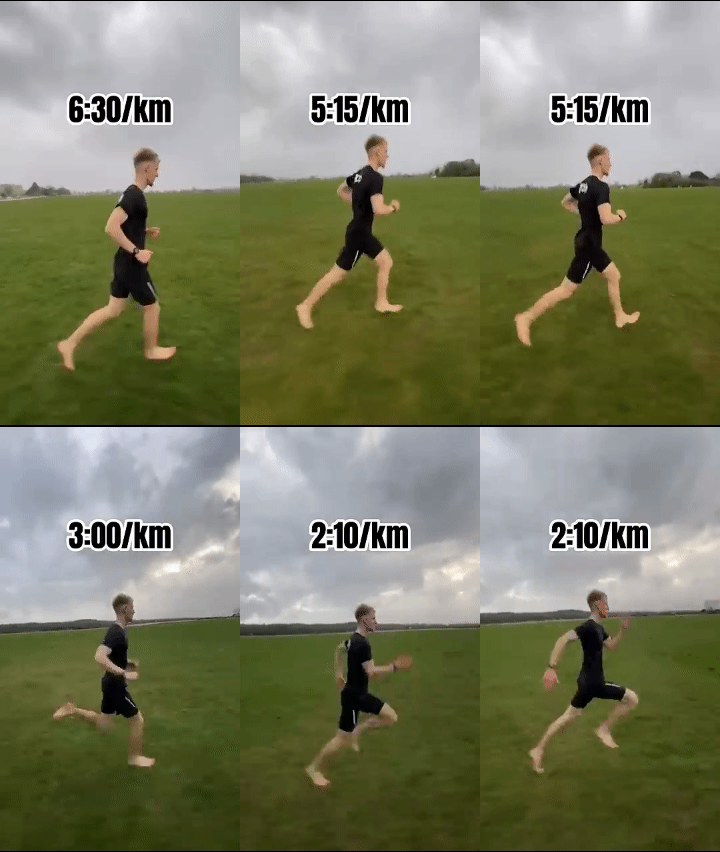
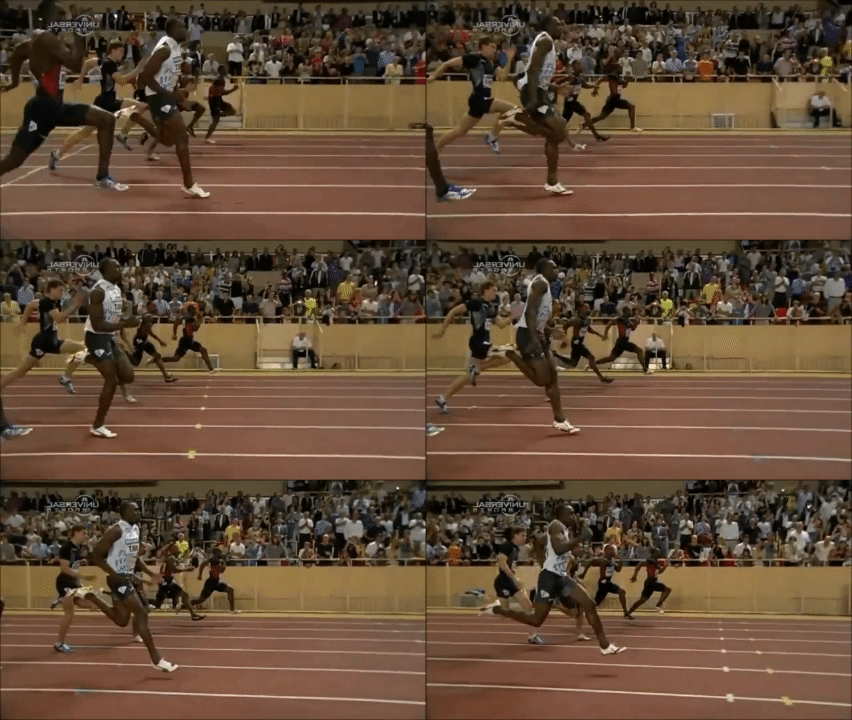
Once max velocity is reached, force generation is only useful to maintain speed rather than increasing it. The runner's main focus at this point is on reducing friction while producing enough force to not lose speed. Compared to normal running, actual vertical displacement of the hips in a sprinter is minimal and seems to glide on the ground. No big up-and-downs means energy is optimized for forward movement.
https://www.youtube.com/shorts/ZFVHf56Om78
Casual running
https://youtu.be/Jd8Jijb7jZY
Sprinting
https://youtu.be/PH-3cHxXAK0
Having too much contact with the ground at this stage can be counterproductive, as the ground can be the main source of friction compared to the flying phase of the running gait. The runner tends to have longer strides with lower frequency.
The first point of change we notice is the strong knee pull at the front, helping build elastic energy for the powerful release and propulsion phase happening next.
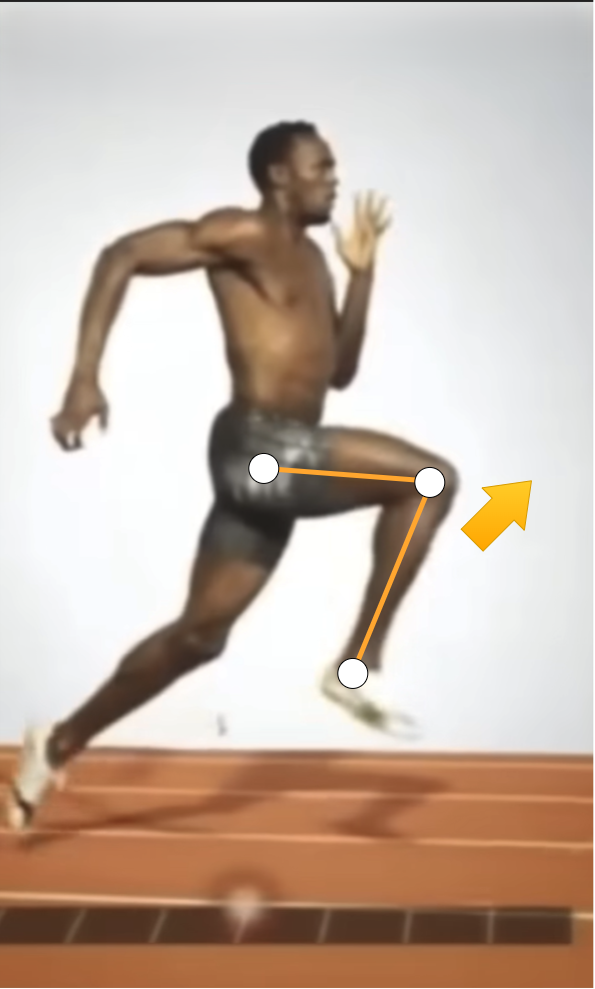
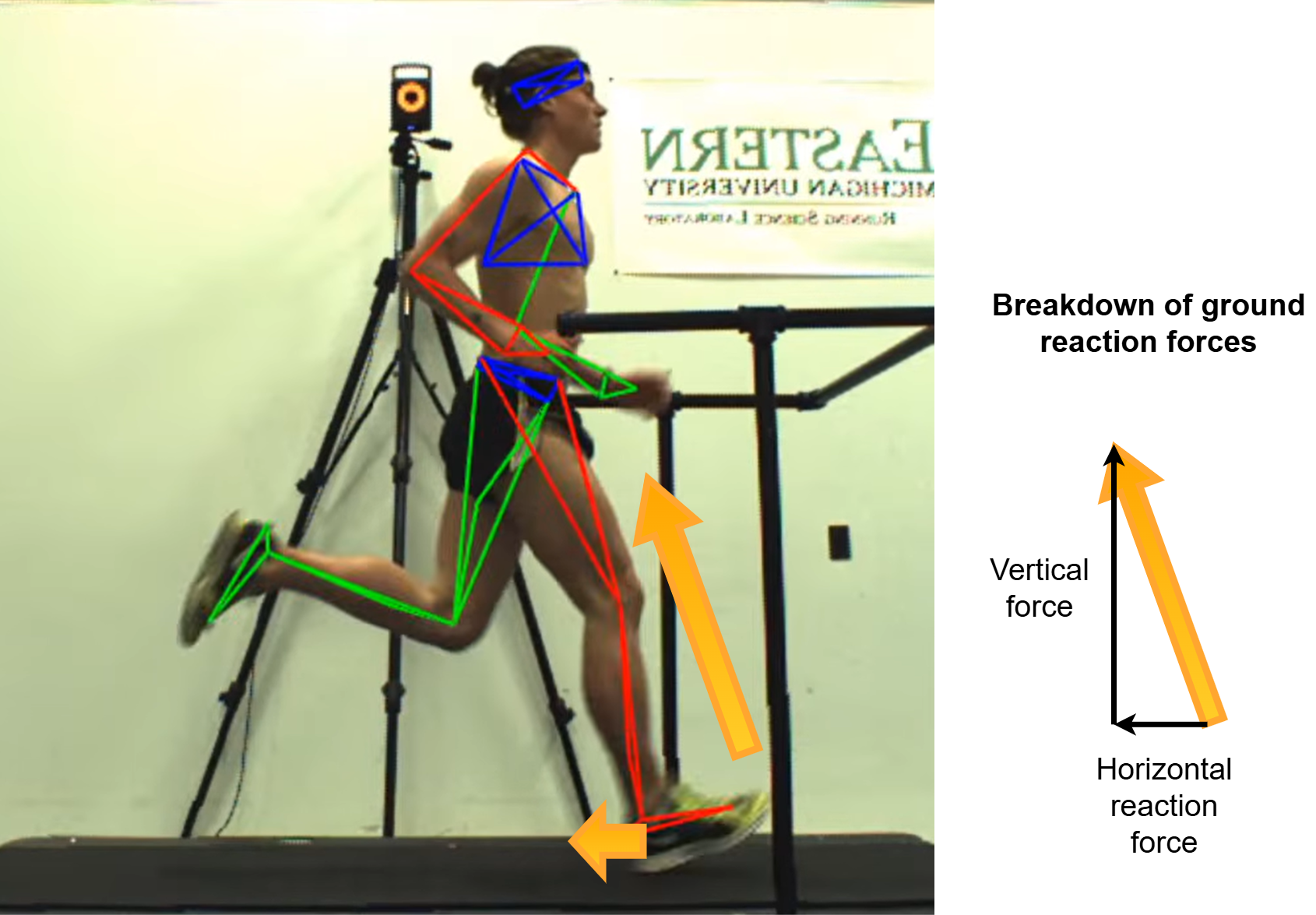
The contact phase is the one that requires a bit more explanation here, as it is one of the key areas of difference. First, we try to reduce the contact time. Less time spent generating force means we can generate it more explosively. It also helps reducing the friction that contact with the ground will create.
Second, the angle of contact can change When the body contacts the ground with the foot extended, a counter force is generated back from the ground in the opposite direction. If the foot falls too far in front of the body, the reaction force will push slightly backward against the body, pushing the body backwards. This will create friction and is counterproductive to our goal.
You may notice how the contact pose of a professional runner always falls as close as possible to the line of the hips, making sure that the force that is produced is maximized to both keep the body up from the ground and push backward to propel the body forward.
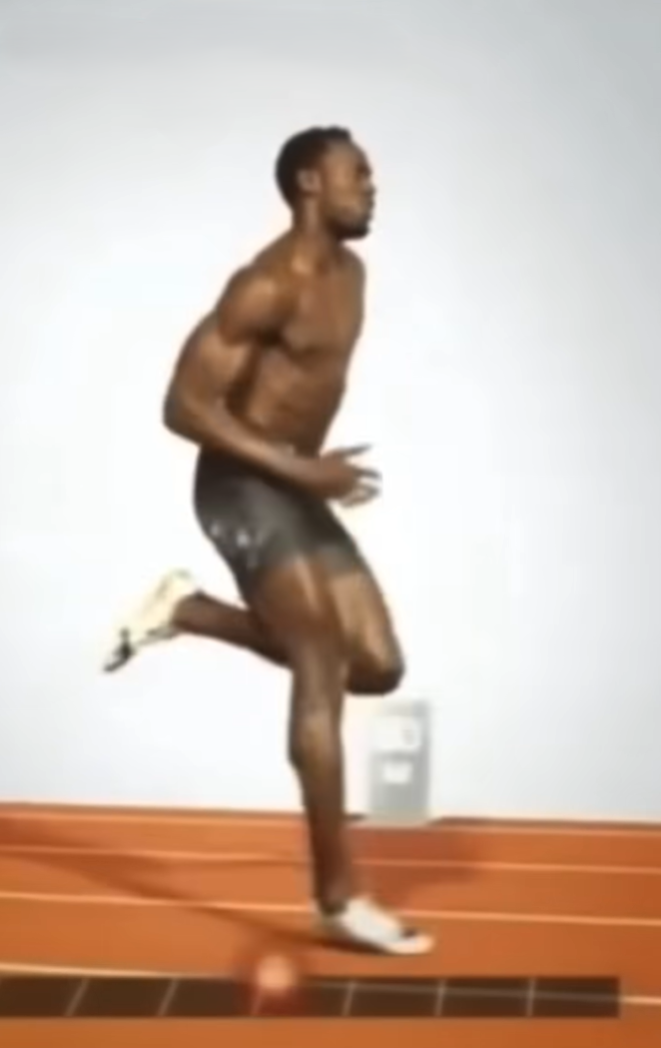
Sprinters never land their foot on the heel; contact is generally produced either at the midfoot or the front foot, pushing the leg behind before forcefully pulling the knee forward.
THE END
Ambulation is a big topic, with many directions of approach based on where the study is coming from and how you're looking to use it. From medical rehabilitation to sport to physics mechanics. In this series, we covered a few of them, from the generic phases and mechanics of gait, looking at what a standard gait looks like, to muscle involvement, looking at how the gait works on the inside, to gait deviation, and at last seeing how walking/running evolves at different speeds. There are always a few related topics that will probably be addressed in different articles but might not be fully relevant to the walking gait in particular. As for now, I don't think I'm left with much more to say. As always, what we covered is the generic standard. Every person moves differently from the next based on physical makeup to personality. Thousands of walking and running variations are out there. But I hope this series has given you the tools to look, dissect, and understand what you see out there. I think these articles covered the main pieces and what can be practical and useful information without derailing into unnecessary details. For today, this is where this series on the walking gait will gently end.
YOU MAY ALSO ENJOY:
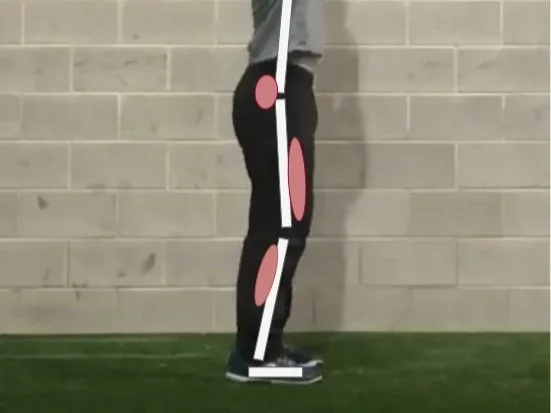
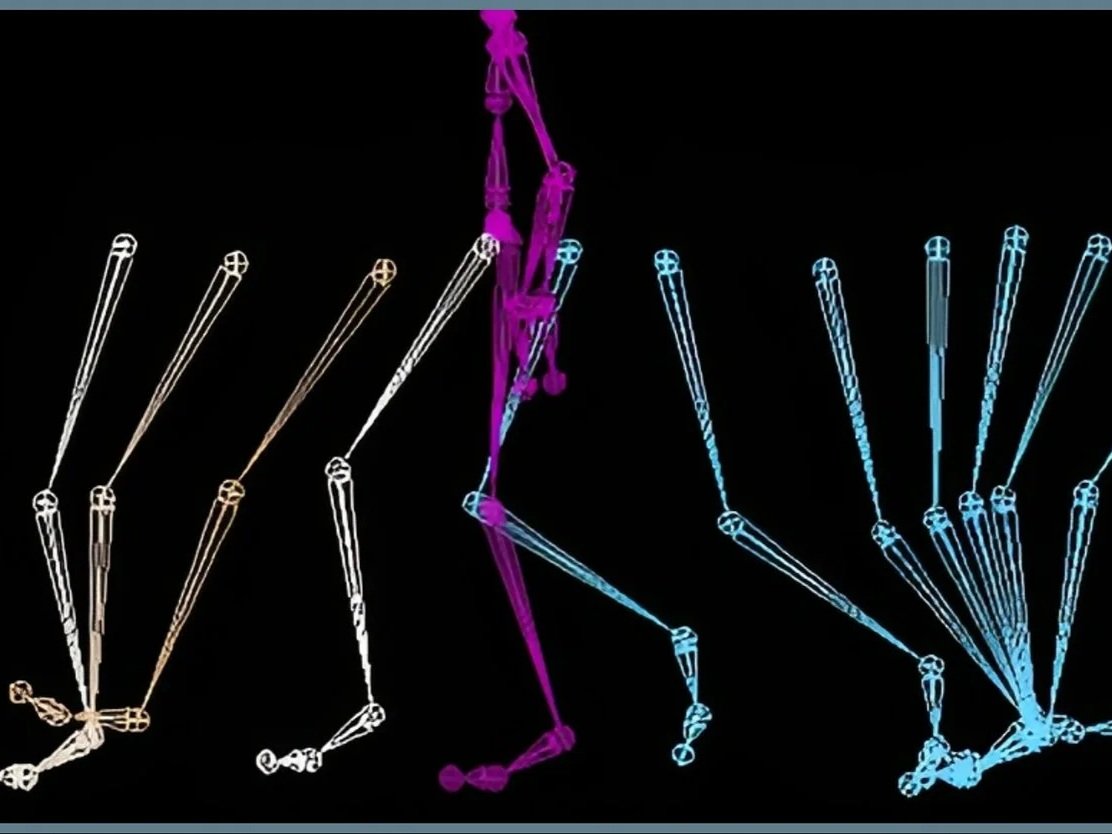
With the knowledge of the previous posts put together, I would like to cover why we tend to anticipate actions. Why does going backward help us move forward, why does going down help us go up, and how does this counterintuitive idea of going in the opposite direction make us move more efficiently?

Bibliography and references
Rose, Jessica. Gamble, James G. Human Walking.
Palastanga, Nigel. Field, Derek. Soames, Roger. Anatomy and Human Movement.
Vaughan, Christopher L. Davis, Brian L. O’connor, Jeremy C. Dynamics of Human Gait.
Ferber, Reed. Macdonald, Shari. Running Mechanics and Gait Analysis.
Thomas K. Uchida, Scott L. Delp: Biomechanics of movement.
Andreas Mayer: The Science of Walking.
Earls, James. Born to Walk.
Arm swing in human locomotion
https://en.wikipedia.org/wiki/Arm_swing_in_human_locomotion
Running
https://en.wikipedia.org/wiki/Running
The Temporal Structure of the Running Cycle, an Essential Element in the Analysis: A Critical Review
https://www.mdpi.com/2673-7078/5/2/40
Running Gait vs Walking Gait: What Is the Difference?
https://rundna.com/resources/running-vs-walking-gait/
Mastering Max Velocity: Key Biomechanics for Sprint Coaches
https://youtu.be/8iYOYFEF4MQ
Fixing Poor Sprinting Form: Frontside & Backside Mechanics
https://youtu.be/bKPie299yWc
Biomechanics Lecture 11: Gait
https://www.youtube.com/watch?v=QB0tJajDvMw&list=PLS-ocxImwSG_VODKg-Ow12FsyGfDC9cnz&index=11
Observational Gait Analysis - Lecture 1
https://www.youtube.com/watch?v=WsnWnvH3PrM&list=PLwSMRX38xS9AVhulUENkZLCraUn3GM6x3
Observational Gait Analysis - Case Study Review
https://youtu.be/USEtXSRkfAU?list=PLwSMRX38xS9AVhulUENkZLCraUn3GM6x3
THE PHASES OF WALKING (GAIT CYCLE BREAKDOWN)
https://youtu.be/QAnEhz6Eqn4?list=PLwSMRX38xS9AVhulUENkZLCraUn3GM6x3
Phases of the Gait Cycle 1
https://youtu.be/JM0EwSlvR1c?list=PLwSMRX38xS9AVhulUENkZLCraUn3GM6x3
Explaining the Gait Cycle for the NPTE
https://youtu.be/dvpi1WHCDwM?list=PLwSMRX38xS9AVhulUENkZLCraUn3GM6x3
Ground Reaction Force During the Gait Cycle
https://youtu.be/Y2RHvicAM2o?list=PLwSMRX38xS9AVhulUENkZLCraUn3GM6x3
Analysis of Gait Motion Frontal Plane
https://youtu.be/SV0dQnimzrg?list=PLwSMRX38xS9AVhulUENkZLCraUn3GM6x3
Analysis of Gait Motion: Transverse Plane
https://youtu.be/H4wXKqmJac4?list=PLwSMRX38xS9AVhulUENkZLCraUn3GM6x3
Analysis of Gait Motion: Sagittal Plane
https://youtu.be/uh7riepyJl4?list=PLwSMRX38xS9AVhulUENkZLCraUn3GM6x3
Running gait - Biomechanics
https://youtu.be/IewLla6LgjI
Gait 101: Breaking Down The Gait Cycle
https://youtu.be/GrywOMf9TAE
Sprinting Biomechanics Explained By Coach Morey Croson: The Complete Gait Cycle When Sprinting
https://youtu.be/Ggsmmj7nsTg
Biomechanics of Running
https://youtu.be/CgEL0iIPj0c
In this article, we are going to revisit most of these points and see how they adapt, apply, and interact at different walking speeds. We'll see how a few things change when we pick up our pace while still remaining in a walk, but also how forces change between a casual person running and a more advanced sprinter.